Is It Worth Correlating Esports Props On DFS Apps?
How prop correlation works across LoL, Dota 2, CS2, Valorant, and CoD — and when stacking correlated legs on PrizePicks actually beats playing them solo.
Understanding how player prop correlation changes your payout and EV is a critical part of getting the best value on your DFS slips. If you're newer to esports betting, this guide walks through what correlation actually means, how each major esport behaves, and where you can still beat PrizePicks on payouts.
- →What correlation is, and why it matters more on DFS apps than traditional sportsbooks
- →How correlation works in LoL, Dota 2, CS2, Valorant, and Call of Duty
- →When stacking correlated props on PrizePicks beats playing them solo, and when it costs you EV
What Is Correlation?
And why it matters more in DFS than anywhere else
Correlation is a measure of how two (or more) outcomes move together. In simpler terms: when you have two bets on your slip, are they secretly working with each other, or against each other?
Outcomes tend to go up and down together. When one bet hits, the other is more likely to hit too.
When one outcome goes up, the other tends to go down. The bets are working against each other.
Take Joe Burrow's passing yards line (249.5) and Ja'Marr Chase's receiving yards line (90.5). If your slip has both players going over, those legs are positively correlated. Every time Burrow completes a pass to Chase, both of their yards stats go up together.
Same play, both stats benefit. That's correlation in action.
Correlating bets in a parlay is nothing new in the betting world. Most traditional sportsbooks (DraftKings, FanDuel, etc.) are aware of which bets are correlated with one another and adjust the payouts to compensate. DFS apps with fixed payouts (like PrizePicks) work differently.
Why PrizePicks-Style DFS Is Different
On PrizePicks, every leg on your slip is treated as independent. The platform pays out based on how many legs hit, not on whether those legs were logically connected. That creates a real opportunity for sharp players, and a quiet trap for everyone else.
Stack positively correlated legs and you boost the chance they hit together, without PrizePicks adjusting the payout to compensate.
Stack negatively correlated legs and you're betting against yourself. When one leg hits, the conditions that made it hit make the other less likely.
In the past, sites like PrizePicks and Underdog did not account for any form of correlation at all. That was one of the craziest edges of all time on DFS apps. In 2026, the books have gotten smarter and now do account for some levels of correlation. But as we'll see, not always enough.
In the following sections, we'll explore how certain props correlate in each major esports league, and review when using correlation is a good thing and when it's a bad thing.
League of Legends & Dota 2
League of Legends is a 5v5 game where two teams compete to destroy the other team's base, called the Nexus. The game has no rounds and no time limit. It ends when one team's Nexus falls, which typically takes anywhere from 25 to 45 minutes depending on how one-sided things get.
Teams earn gold by killing enemy champions, taking towers, and securing map objectives. That gold buys items that make your champion stronger, creating a snowball effect: the winning team becomes increasingly harder to stop, while the losing team is dying, not getting kills, and not stacking assists.
That snowball is exactly what makes LoL and Dota 2 so easy to correlate. When one team is rolling, every player on that team is piling up stats. Every player on the other team is sitting at base, waiting to respawn.
Dota 2 follows the same structure. The one difference worth noting is that Dota 2 tends to produce higher kill totals due to longer games and a buyback mechanic that lets dead players re-enter fights immediately. More variance in individual numbers, but the correlation logic is identical.
CS2 & Valorant
CS2 and Valorant are both round-based tactical shooters where two teams alternate attacking and defending. Each map is first to 13 rounds wins. If the score reaches 12–12, the map goes to overtime until one team breaks the tie. This makes them fundamentally different from LoL and Dota 2.
The biggest factor for correlation here is how many rounds get played. A blowout ends fast (think 13–3 or 13–5), while a closely contested match plays out longer and can stretch into overtime. More rounds means more chances for stats to pile up — for everyone in the match.
Because of this, the best way to build correlated props is to take all players in the same direction: all overs or all unders, whether the players are on the same team or across both teams. The direction is what matters, not which team you're pulling from.
Mixing overs and unders from the same game on the same slip is one of the worst things you can do. It significantly kills the EV of your bet and puts your legs in direct conflict with each other. If the game goes long, your overs cash but your unders die. If the game is short, the opposite happens.
Call of Duty
Call of Duty matches are best of five, with each map played on a different game mode in a fixed rotation: Hardpoint, Search and Destroy, Control, Hardpoint, Search and Destroy.
Correlation in CoD is driven by map and game mode rather than total rounds the way it is in CS2. The game modes are fundamentally different from each other, so what happens on Map 1 tells you almost nothing about what will happen on Map 2.
Here's how correlation breaks down across a CoD series:
Within a single map. Especially Map 1 and Map 3 (Control), where teammates tend to move together.
Series-level (Maps 1–3 combined). Some correlation across the full prop slate, but weaker than staying within a single map.
Across maps. Correlation drops off sharply. Map 1 and Map 3 are essentially independent of each other.
Quick Reference: When to Correlate
| Sport | How to Correlate | Worth It? |
|---|---|---|
| LoL / Dota 2 | Same team, same direction | Sometimes |
| CS2 | All overs or all unders, same game | No |
| Valorant | All overs or all unders, same game | Yes |
| Call of Duty | Same map (1 & 3), same team | Sometimes |
The Takeaway: Math Over Vibes
Now that you have a high-level understanding of how correlation works for esports betting, the important thing to keep in mind is how much correlation is being priced in.
Correlation is a great way to enhance your edge, or even get an edge in the first place. But just because something is correlated does not make it +EV. The math has to check out. Let's walk through two real examples: one where correlation hurts you, and one where it helps.
“Model bet” = a pick the LCSLarry model flags as positive-EV at high confidence. In every example below, each leg is a 60% probability bet (-150 in betting odds) from the model.
Bad correlationCS2 Example
Below are two PrizePicks slips, both built from model bets:
- The left slip pays 5x. Two of its legs are correlated: PKL and detr0ittJ are both on Fake do Biru, both going OVER on MAPS 1–2 Kills in the same match against ODDIK. Same team, same direction, same game — that's the correlation.
- The right slip pays 6x for 3 non-correlated model bets, with each leg coming from a different match.
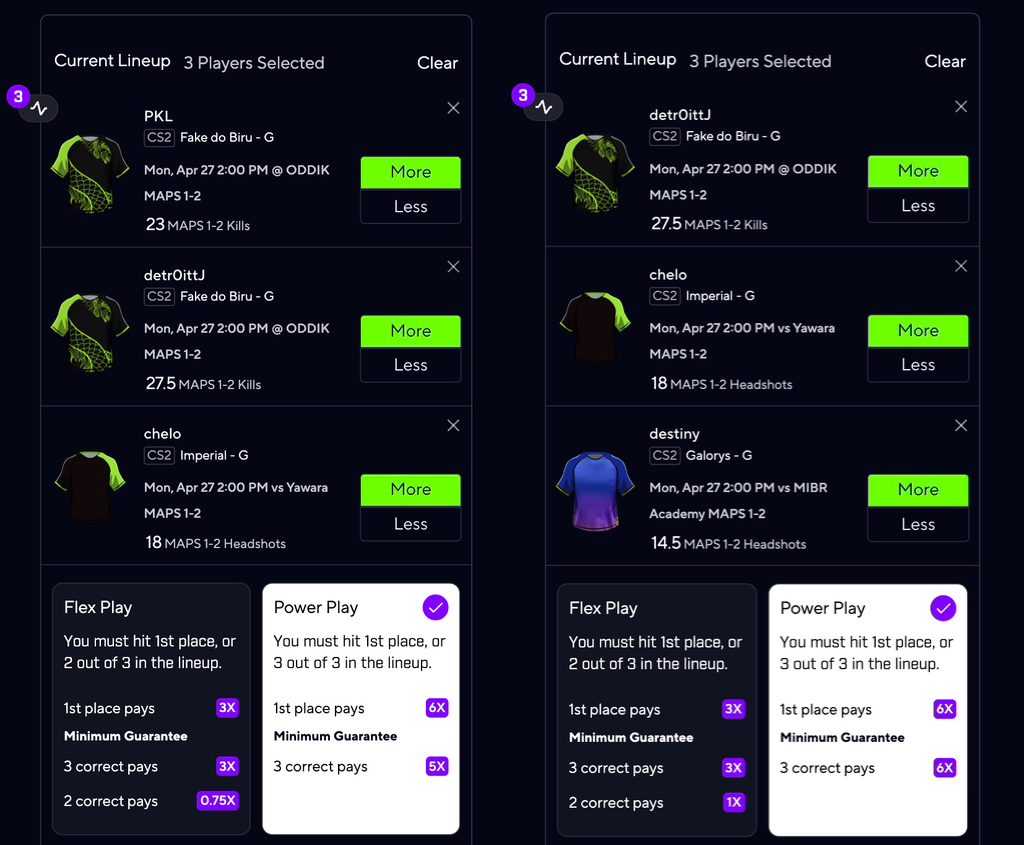
Notice the correlated slip on the left pays only 5x, while the non-correlated slip on the right pays 6x. PrizePicks is acknowledging the correlation between the two Fake do Biru props by shading the payout. In this scenario, it's more EV to play the 6x non-correlated slip since your edge is higher. Why? Let's review the math.
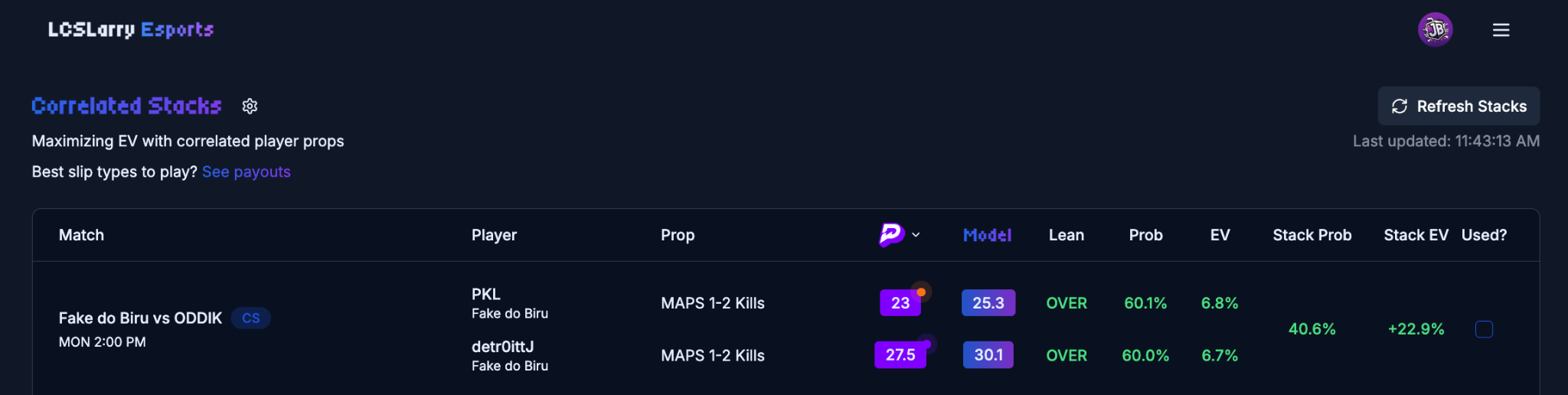
The fair value (FV) of the correlated stack is 40.6%. In betting odds, that's +146. This means this correlation stack will win 40.6% of the time. The third leg is also a 60% (-150) probability bet.
Even though the 6x slip has a lower implied win rate, the EV is higher because of the final odds we're getting. So for CS2, it's best to avoid correlation on PrizePicks.
Good correlationValorant Example
PrizePicks and most DFS apps are aware of basic correlation, but in Valorant they're still not nerfing the fixed payouts enough. Same setup as before: two PrizePicks slips, both built from model bets.
- The left slip pays 5.75x. Two of its legs are correlated: bdog (Evil Geniuses Academy) and satellite (Shopify Rebellion Black) are in the same Valorant match against each other, both going OVER on MAPS 1–2 Kills. If the match goes long, both players accumulate kills together.
- The right slip pays 6x for 3 non-correlated model bets, with each leg coming from a different match.
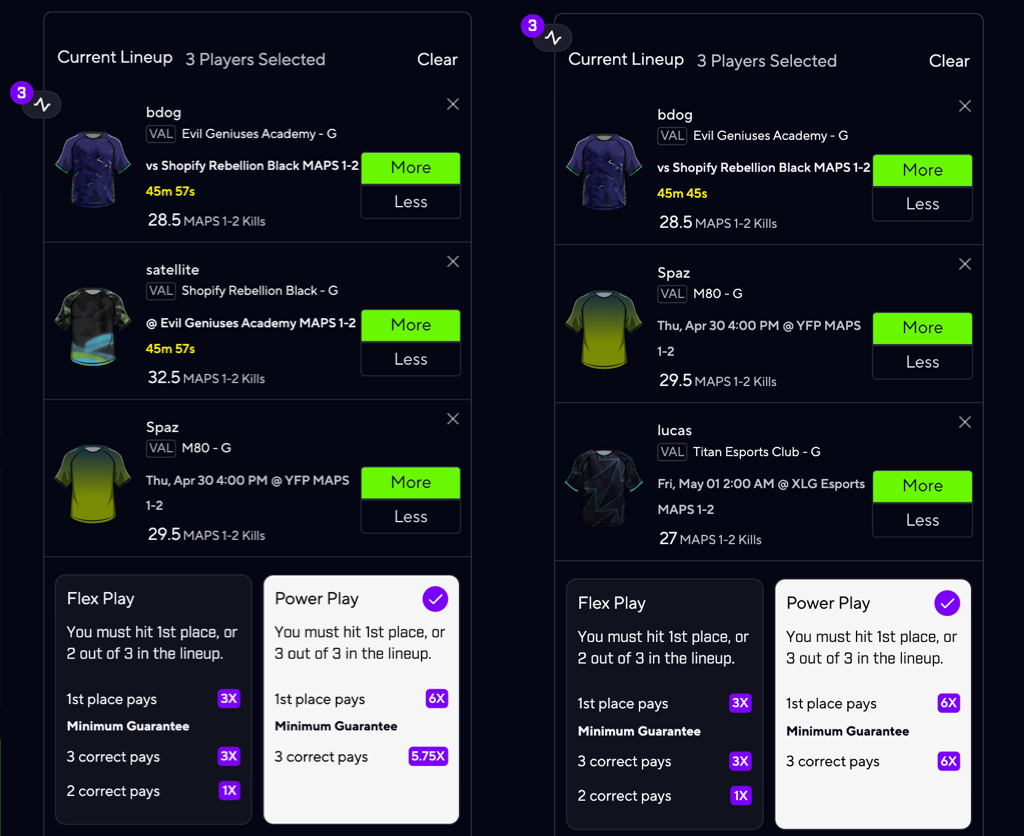
Same pattern as the CS2 example: the correlated slip on the left pays 5.75x, while the non-correlated slip on the right pays 6x. PrizePicks is acknowledging the correlation between the two same-match Valorant props by shading the payout. But this time the reduction is not enough to offset the correlation boost, which is good for us. In this scenario, it's more EV to play the 2-man correlation stack on the left. Let's review the math.

The fair value of the correlated stack is 36%. In betting odds, that's +177. This means this correlation stack will win 36% of the time. The third leg is also a 60% (-150) probability bet.
The 5.75x slip is more EV and will win more often, making it the superior choice between the two options.
The Bottom Line
Correlation is a real edge on DFS apps, but only when the payout reduction lags the actual correlation strength. Stack two correlated legs that PrizePicks didn't shade enough, and you've raised your hit rate without paying for it. Stack two correlated legs they did shade enough, and you're leaving EV on the table.
- Lean in: Valorant. PrizePicks consistently under-prices correlation on same-match props.
- Avoid: CS2. The payout reduction outpaces the win-rate boost.
- Sometimes: LoL, Dota 2, Call of Duty. Check the payout shift and devig if you're unsure.
Doing all of this manually for every slip across five esports is impossible. That's exactly what the LCSLarry slip builder does. It auto-builds +EV slips for you and decides, on the fly, whether a correlated stack or a non-correlated build has higher EV given the actual PrizePicks payout. If correlation enhances the edge (like in Valorant), it leans into it. If correlation costs EV (like in CS2), it skips it. Same math you just learned, run automatically against the live slate across all 12 sportsbooks.
The screenshots above came from the Correlated Stacks dashboard inside the platform: the view that exposes the underlying correlation math the slip builder uses to make those decisions.
Try it yourself
Auto-built +EV slips across LoL, Dota 2, CS2, Valorant, and Call of Duty, with correlation handled for you. Start a free 3-day trial. Five esports, twelve sportsbooks, no devigging required. Takes about 15 minutes a day once you get the hang of it.
Disclaimer
Betting involves risk, and past performance does not guarantee future results. Please bet responsibly.